Urban Forestry--What will make a difference?
Hi Friends,
At the Urban Forestry Commission meeting , the Office of Sustainability & Environment said a letter had been sent to the City Council, explaining the tardiness of the dozen or so reports required by Resolution 31138. Are all these reports excused?
On Tuesday, a Determination of Non Significance was issued by DPD for adding the Green Factor landscaping requirements to electrical substations & solid waste transfer stations in Industrial Zones, so that takes care of one of the reports, right?
When are we going to find out about parking lot shading, planting under powerlines, pruning for housemoving, and the PR campaign for Seattle ReLeaf, etc.? When will the lists of Exceptional Trees and Heritage Trees be published? When will the 5 recommendations by the Seattle City Auditor's report be addressed? All of these thing were supposed to be done by Spring, 2010.
BTW, I am a co-appellant in the lowrise multifamily appeal of the DNS. The city attorney said twice during the 5-day hearing that the Urban Forest Management Plan (UFMP) has not been officially adopted by the city. Due to the city attorney's month long vacation, final arguments are not due till September, and a decision is expected by the Hearing Examiner around October 23rd.
The Urban Forestry Commission does not have on its work plan a process for examining the UFMP. The Commission also has declined to address the discrepancy between the Council's 40% canopy cover goal and the UFMP's goal of 30%. Which is it? Perhaps the 2 upcoming meetings with the facilitator can get the Commission out of reactive mode, and back towards a goal oriented process.
What is the bigger picture?
The problem with the UFMP is it primarily concerns itself with only 1 of the 4 criteria of tree assessment, Location. The other 3 tree components of a tree are its Species; its Size (expressed in trunk diameter); and its Condition. These 3 skimmed-over factors simply cannot be seen from a satellite orbiting in space. Satellite photos also completely miss the understory layer of canopy. Our cheapo tree inventory is based on locational criteria in these satellite photos, so we actually need to get out there & catalog each tree in a database to obtain truly effective tree management capability.
It took several follow up questions by Urban Forestry Commissioners at yesterdays meeting to get staff to reveal that the initial statement that ground truthing is only a proposal, and NOT a part of the 2007 canopy survey. This 2007 survey is partly based on satellite images that were taken on a foggy day, yet it is being misconstrued as being definitive, which it is not. It is merely an apples and oranges comparison, yet it is being pawned off as an actual increase in canopy, as can be seen in the video of the DPD presentation I shot yesterday.
If the city had a tree inventory, it would become instantly obvious that a budget would be necessary to correct problems with defective trees. I believe the city would have a severe case of sticker shock at the number of tree crews needed to address maintenance issues of our 1.3 million tree urban forest. We currently have 15 field arborists, arranged in 5 crews of 3 city employees each. That's 6 arborists to handle the 150,000 trees between the sidewalk & the curb, and 9 arborists to deal with 150,000 trees in developed parklands. This is a skeleton crew handling a very valuable resource. We need to triple this number of staff arborfists, according to a 2009 editorial by PlantAmnesty.
How do other cities obtain their tree maintenance funding? Stormwater fees. Seattle conveniently wrote its 2009 stormwater ordinance prior to the appointment of the Urban Forestry Commission. We could have offered a drainage discount to properties with a large proportion of exposed soil and planted trees. Such properties soak up water, and do not tax our drainage facilities, and they should pay less. Remaining properties with extensive lot coverage by impervious roofs & slabs should pay more to deal with the trees that intercept, transpire, and infiltrate up to 30% of the rainwater falling on Seattle.
Problem solved. What's wrong with our city government? What's right is that we now have an active citizen advisory board sending recommendations to the Mayor. Still absent, however, is a citizen non profit organization unencumbered by the bureaucracy.
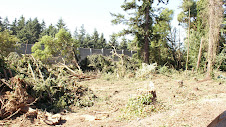
Save The Trees Seattle has recently expanded focus from the battle to save the forest from construction of new classrooms at Ingraham High School. Save The Trees Seattle is a registered non profit dedicated to completing the tripartite formula of successful partnership with the city government. The current staff and citizen advisory board will now be complemented with a true representative organization of the grassroots citizens.
Arboreally yours,
Michael Oxman
(206) 949-8733
www.SaveSeattlesTrees.com
Ingraham Trees

Snow
Clear cutting along 123rd in Seattle

No comments:
Post a Comment